Interactive App: GW Explorer
From Camp Handouts to a Browser Exhibit
For the 2024 PSU Science-U Gravitational Waves Camp I wrote a set of Python apps to teach students how a compact binary coalescence (CBC) search works, alongside a standalone Dash tool for digital filter design. They did the job, but each needed a Python server, and the physics leaned on LALSuite and SciPy running behind the scenes.
GW Explorer is the browser-native successor: a single-page app that consolidates those tools into one guided exhibit and moves all of the physics into the browser itself.
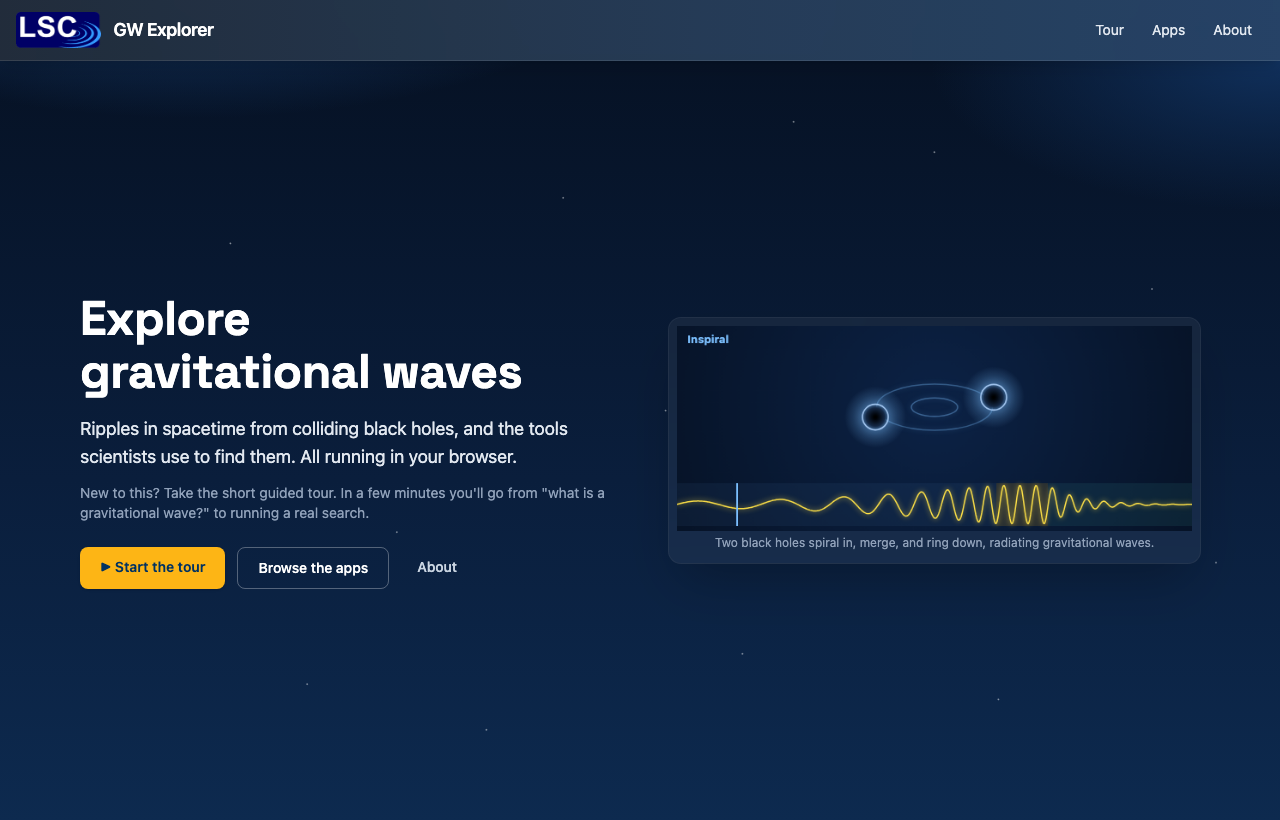
What’s Inside
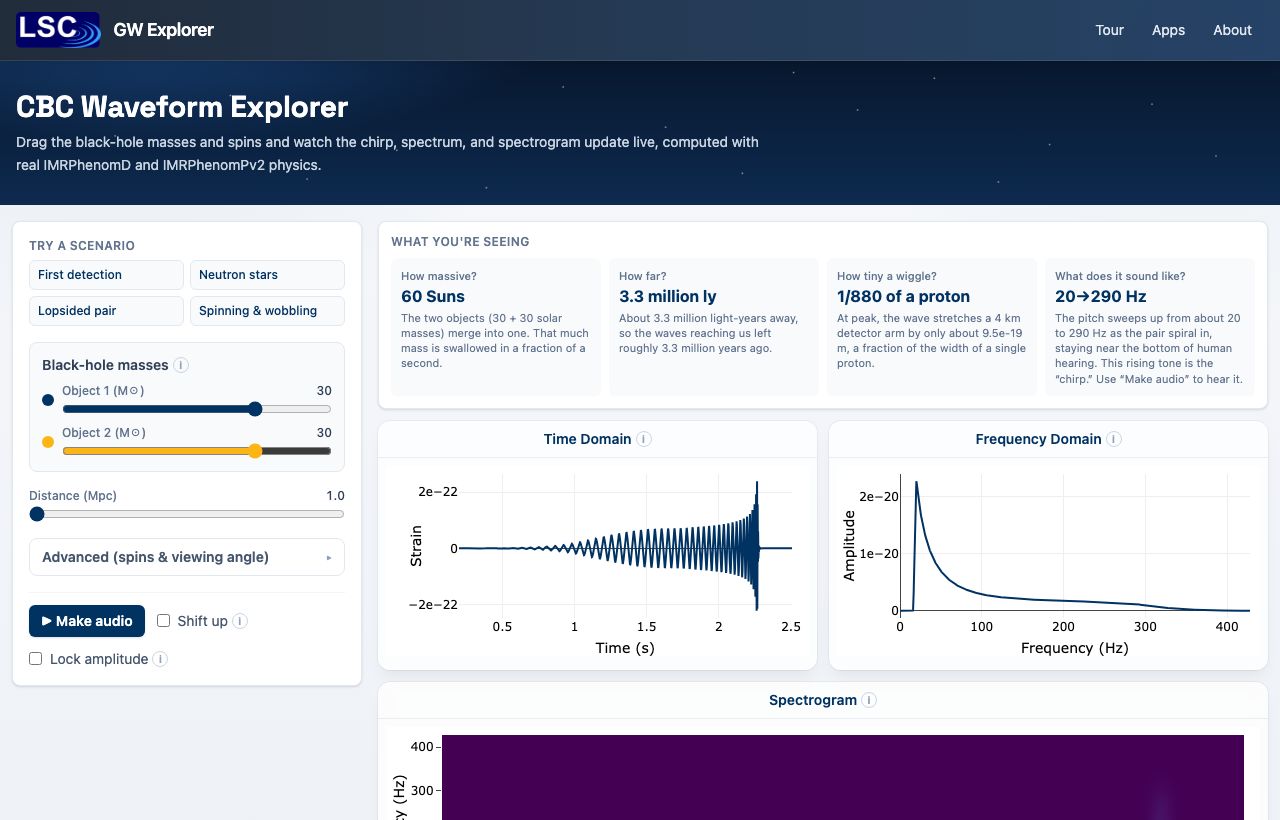
- CBC Waveform Explorer: Dial in component masses and spins and watch the time-domain strain, the frequency-domain amplitude, and the spectrogram update live, using real IMRPhenomD and precessing IMRPhenomPv2 waveforms.
- DSP Filter Explorer: Drag poles and zeros and see the Bode and impulse responses respond in real time, the successor to my earlier Dash filter app.
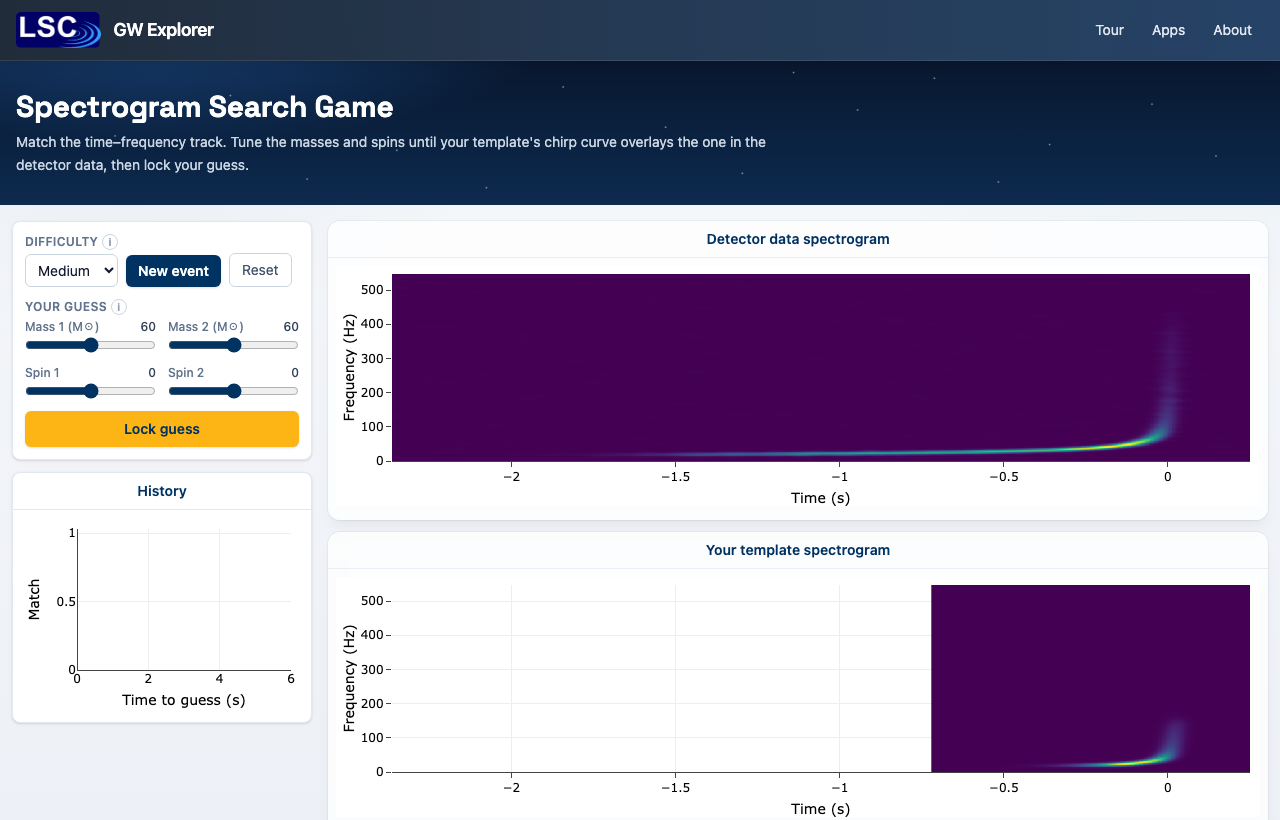
- Search games: Four ways to play a parameter-estimation search (visual, audio, spectrogram, and matched-filter SNR), tuning masses and spins until your template matches a hidden event.
Putting LALSuite in the Browser
The interesting engineering was removing the server. The original apps generate waveforms with LALSuite’s lalsimulation. Because IMRPhenomD is an analytic, closed-form frequency-domain model rather than a numerical simulation, I could port its actual equations and calibrated coefficients (and the IMRPhenomPv2 precession layer) directly to TypeScript, the same way the old app ported SciPy’s filter routines.
The result is a genuine waveform approximant running entirely client-side. It is validated against reference waveforms dumped from LALSuite: the PhenomD strain matches to better than one part in \(10^5\), and the precessing PhenomPv2 polarizations agree to comparable precision across single- and double-spin systems. There is no server, no LALSuite, and no SciPy in the deployed app.
Tech Stack
GW Explorer is built with Vite and TypeScript, React 19 and Tailwind CSS, a hash router for clean GitLab Pages hosting, Zustand for state, and Plotly.js for the graphics. The build is fully static, and the whole exhibit, physics included, runs from a single set of files with nothing behind it.