New Paper: Fisher Information Velocity, a Geometric Channel for Glitch Identification
Limitations of Energy-Based DetChar
Gravitational-wave detectors are exquisitely non-stationary, and telling an instrumental glitch from an astrophysical signal is the daily work of detector characterization (DetChar). Most DetChar tools are energy-based: band-limited root-mean-square (BLRMS) monitors, for instance, watch the power in a frequency band and raise a flag when it spikes.
The trouble is that energy alone is ambiguous. A uniform gain change that lifts every frequency looks, to a BLRMS monitor, much like a physical reconfiguration that redistributes power across the spectrum, even though only the latter reshapes the noise in a way that can masquerade as, or bury, a signal. Energy-based metrics conflate global amplitude scaling with genuine spectral warps. This paper, with Zach Yarbrough, introduces a channel built to tell them apart. [1]
A Geometric Model of the Noise Floor
We model the detector’s power spectral density (PSD) as a point on a Riemannian manifold, with the Fisher information metric supplying the notion of distance between spectra. As the noise floor evolves, that point traces a trajectory, and its velocity is our diagnostic: Fisher information velocity.
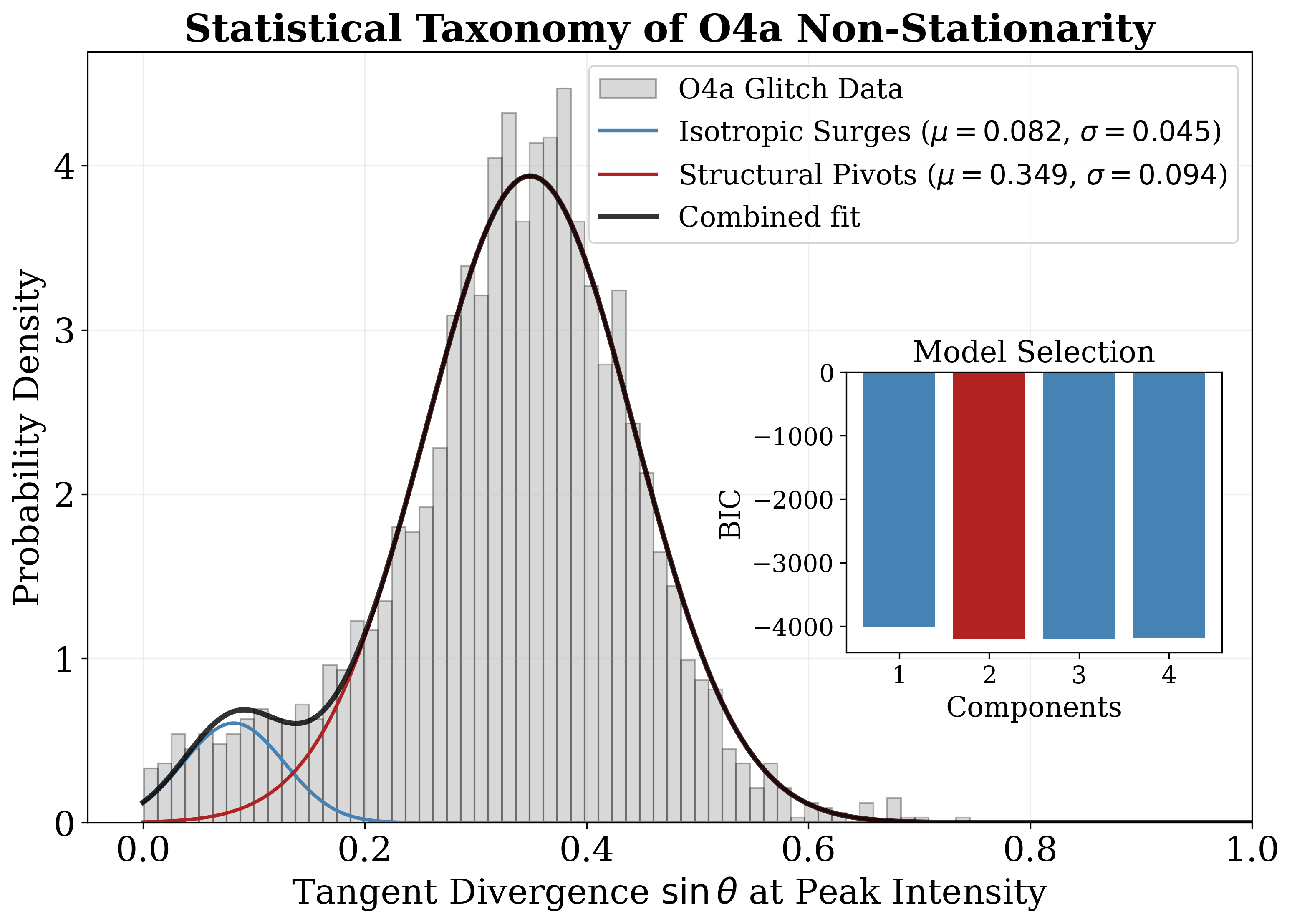
The key move is to decompose that velocity geometrically. Using exterior algebra we compute the tangent divergence (\(\sin\theta\)), the component of the motion that points across the manifold rather than radially outward. A pure energy surge moves the PSD radially (a rescaling) and contributes little tangent divergence; a spectral warp bends the trajectory sideways. Measuring \(\sin\theta\) therefore decouples simple amplitude surges from differential redistributions of power across frequency bands.
Results on O4a Data
We implemented the channel as the sgn-drift streaming pipeline and ran it over \({\sim}40\) hours of high-cadence Advanced LIGO O4a data, evaluating \(N = 282{,}080\) independent manifold velocity samples. Mapping the phase space at high resolution reveals a clean bimodal taxonomy of severe instrumental non-stationarity: structural pivots (spectral warps) account for \(87.2\%\) of events, and isotropic surges (global energy changes) the remaining \(12.8\%\).
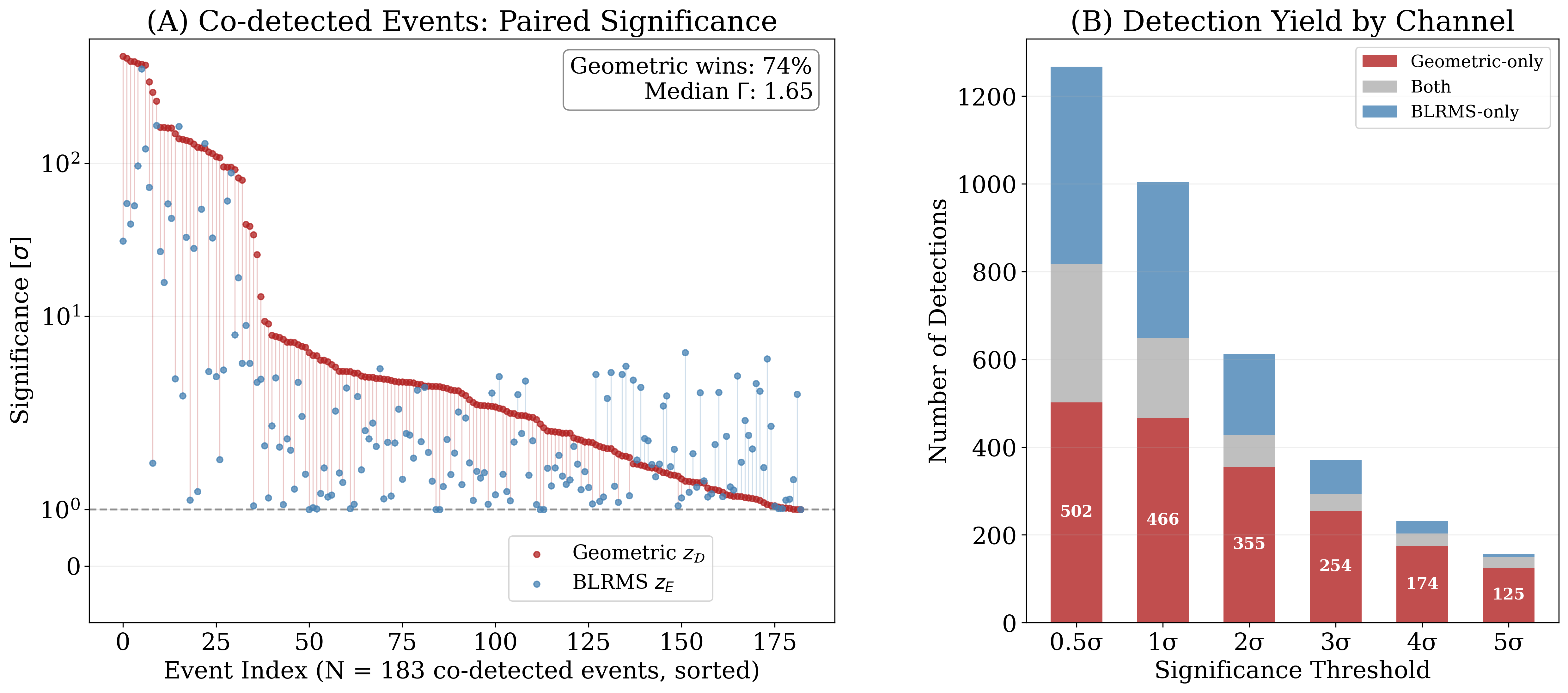
The geometric channel does more than restate what BLRMS already sees. Among co-detected events it achieves higher significance than standard BLRMS monitors in 74% of cases, with a median sensitivity ratio of \(\Gamma = 1.65\). The two methods also flag largely non-overlapping populations, so folding in the geometric channel grows the union catalog of flagged instrumental events by 87% relative to BLRMS monitoring alone.
Robustness to Astrophysical Signals
A DetChar channel is only useful if it does not eat real gravitational waves. We validated the channel on 10 confirmed GWTC-4.0 events and \({\sim}5{,}000\) simulated injections and found it robustly insensitive to astrophysical signals: a compact-binary chirp does not register as a spectral pivot. That makes Fisher information velocity a sensitive, complementary, and veto-safe diagnostic, ready to sit alongside existing monitors in current and next-generation detector networks.