New Paper: Gauge Theoretic Signal Processing II, Zero-Latency Whitening for Early Warning
Motivation
Early-warning gravitational-wave alerts live and die by latency. Every second between a merger and its public alert is a second in which an optical telescope could already be slewing toward the kilonova. Yet today’s low-latency pipelines whiten their data with acausal, linear-phase filters that need a look-ahead buffer, and that buffer alone injects several seconds of algorithmic delay.
The obvious fix, causal minimum-phase whitening, is subtle in practice. Under non-stationary noise you cannot simply swap the filter type: the drifting PSD must be tracked without eroding matched-filter SNR, each filter update must stay minimum-phase, and the altered phase response must be compensated so sky localization does not suffer. In Paper I we showed the minimum-phase connection gives a geometrically exact update rule for exactly this situation. This paper validates that framework numerically, operationally, and at production scale. [1]
Certifying Flatness in Practice
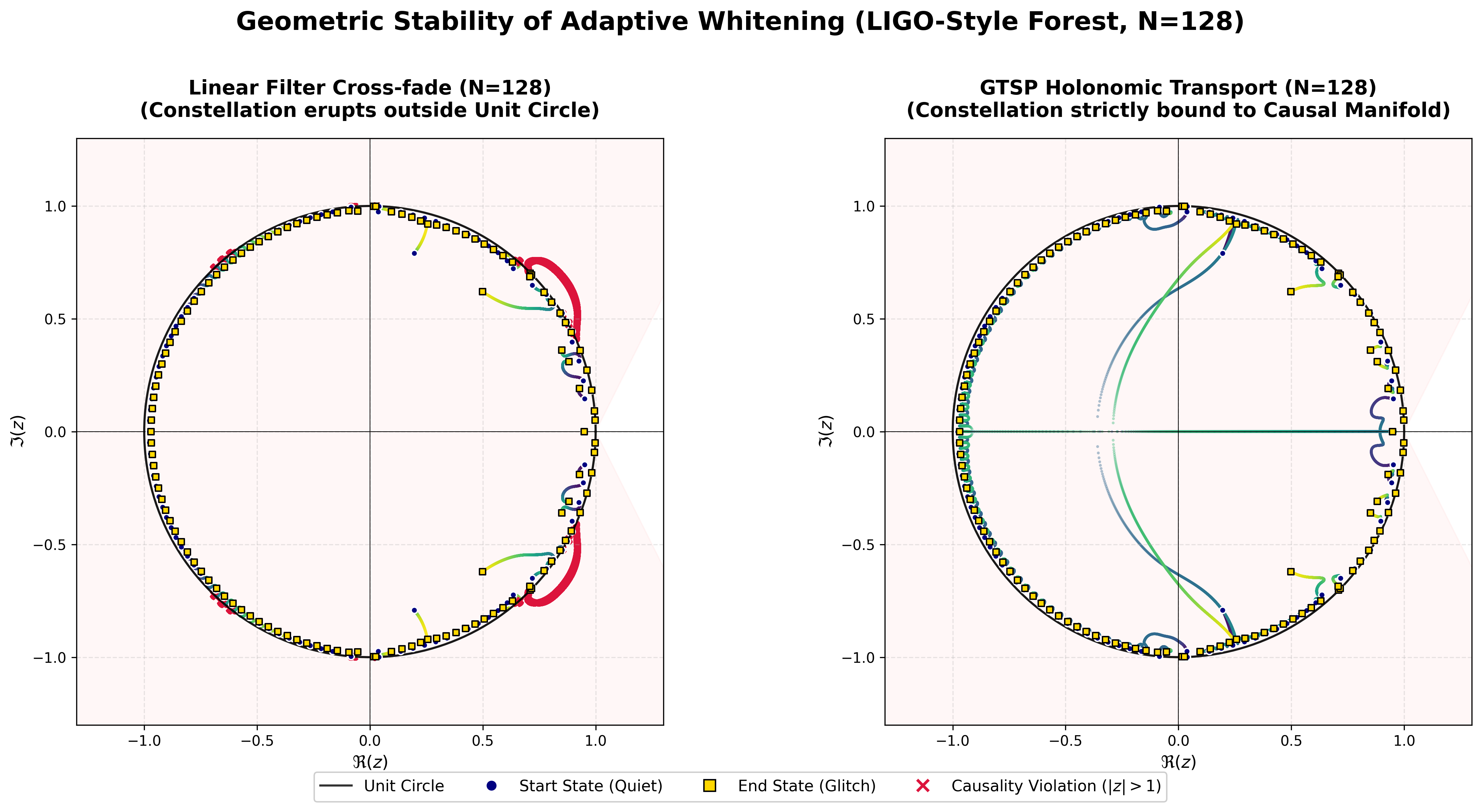
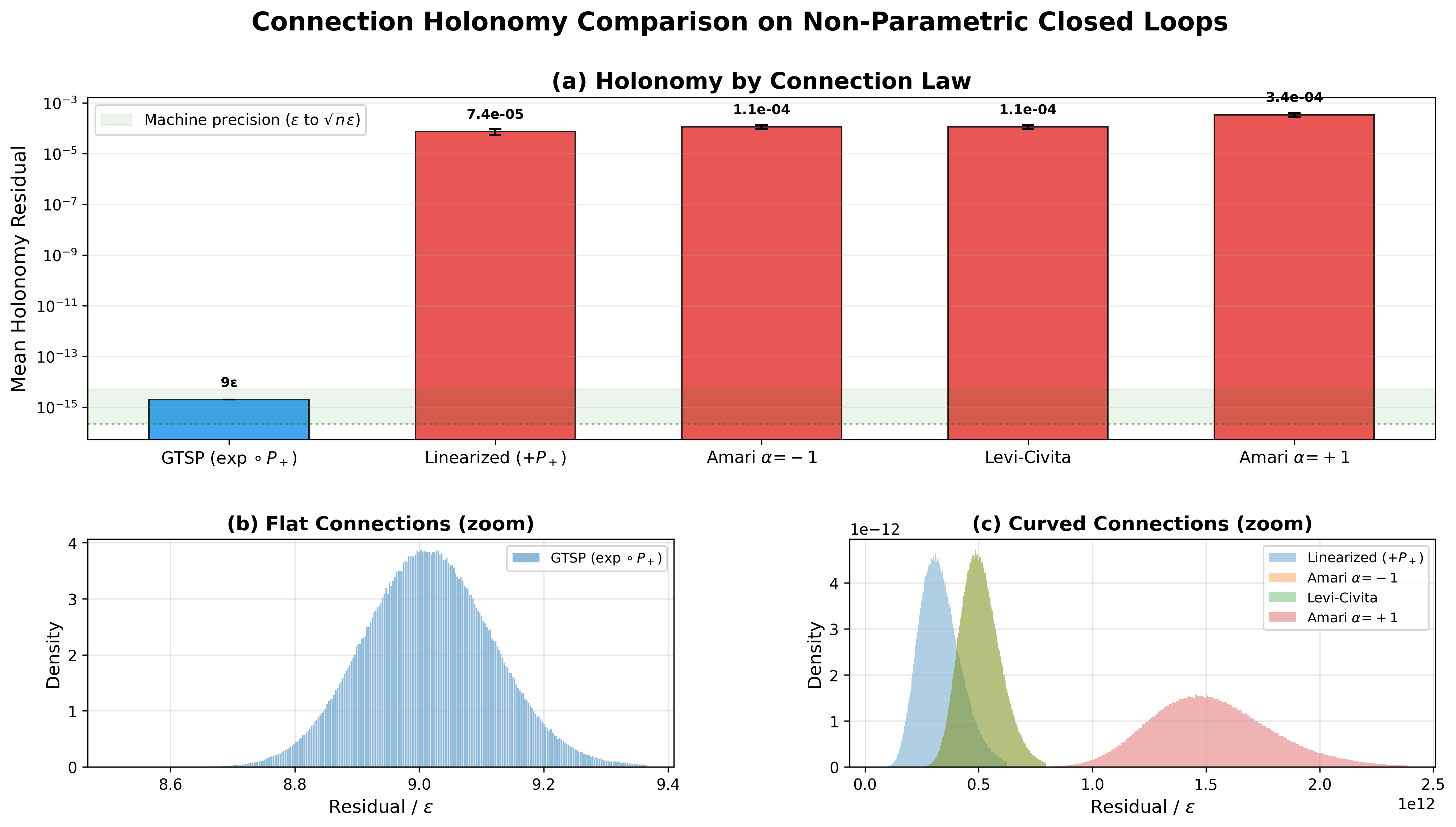
We first confirm the theory’s two load-bearing claims directly on data: parallel transport along the minimum-phase connection strictly preserves the minimum-phase property and exactly conserves matched-filter SNR. We then numerically certify the connection’s flatness, verifying that the optimal filter is a path-independent state function of the instantaneous noise, just as the flatness theorem predicts.
An O3 Injection Campaign
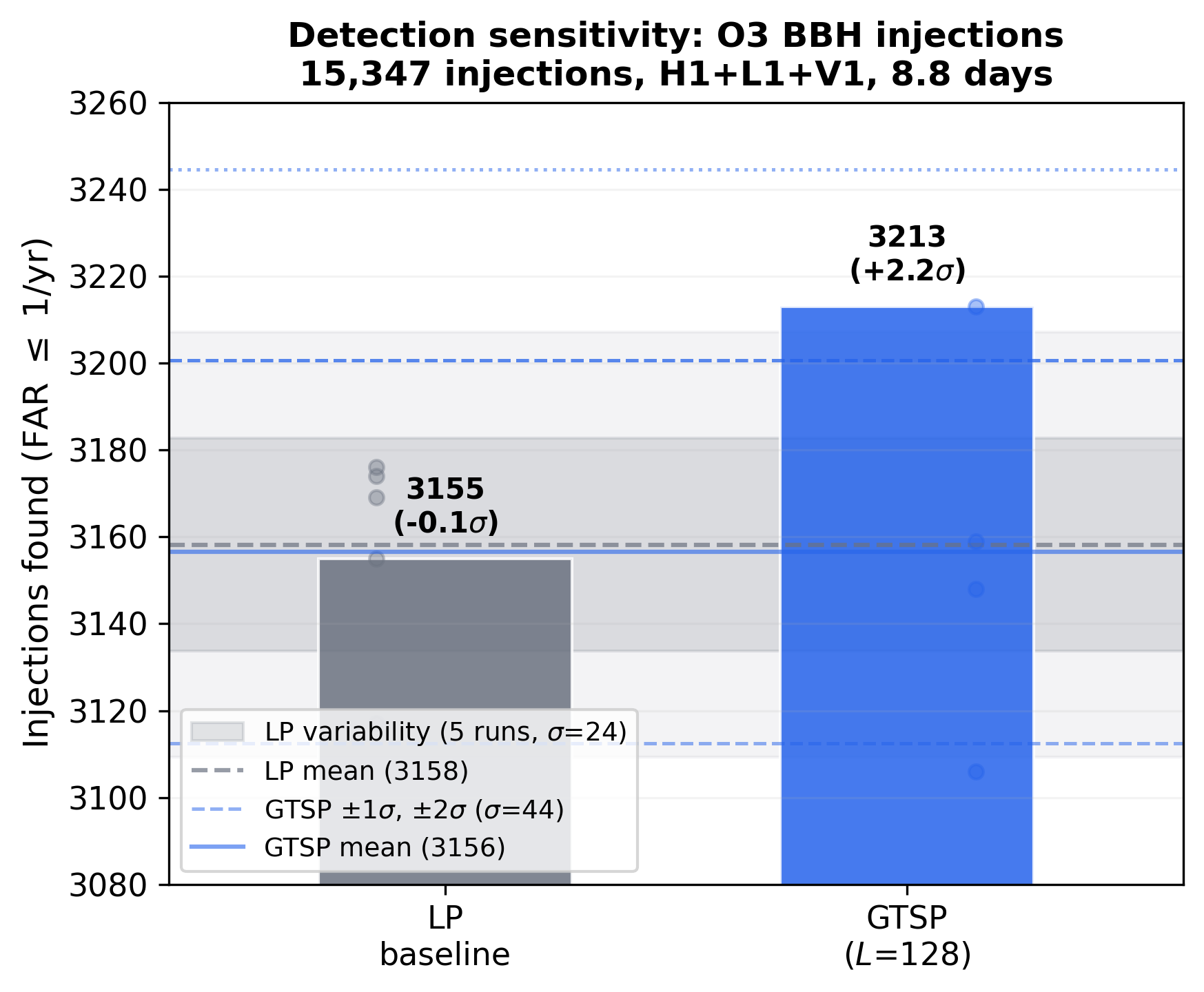
To show the causal architecture loses no science, we ran an injection campaign on O3 data with 15,347 binary black hole signals across the LIGO–Virgo network. The zero-look-ahead whitening reproduces the sensitivity of the standard linear-phase baseline, and preserves inter-detector timing and phase accuracy, the quantities that determine sky-localization quality.
Operational Impact
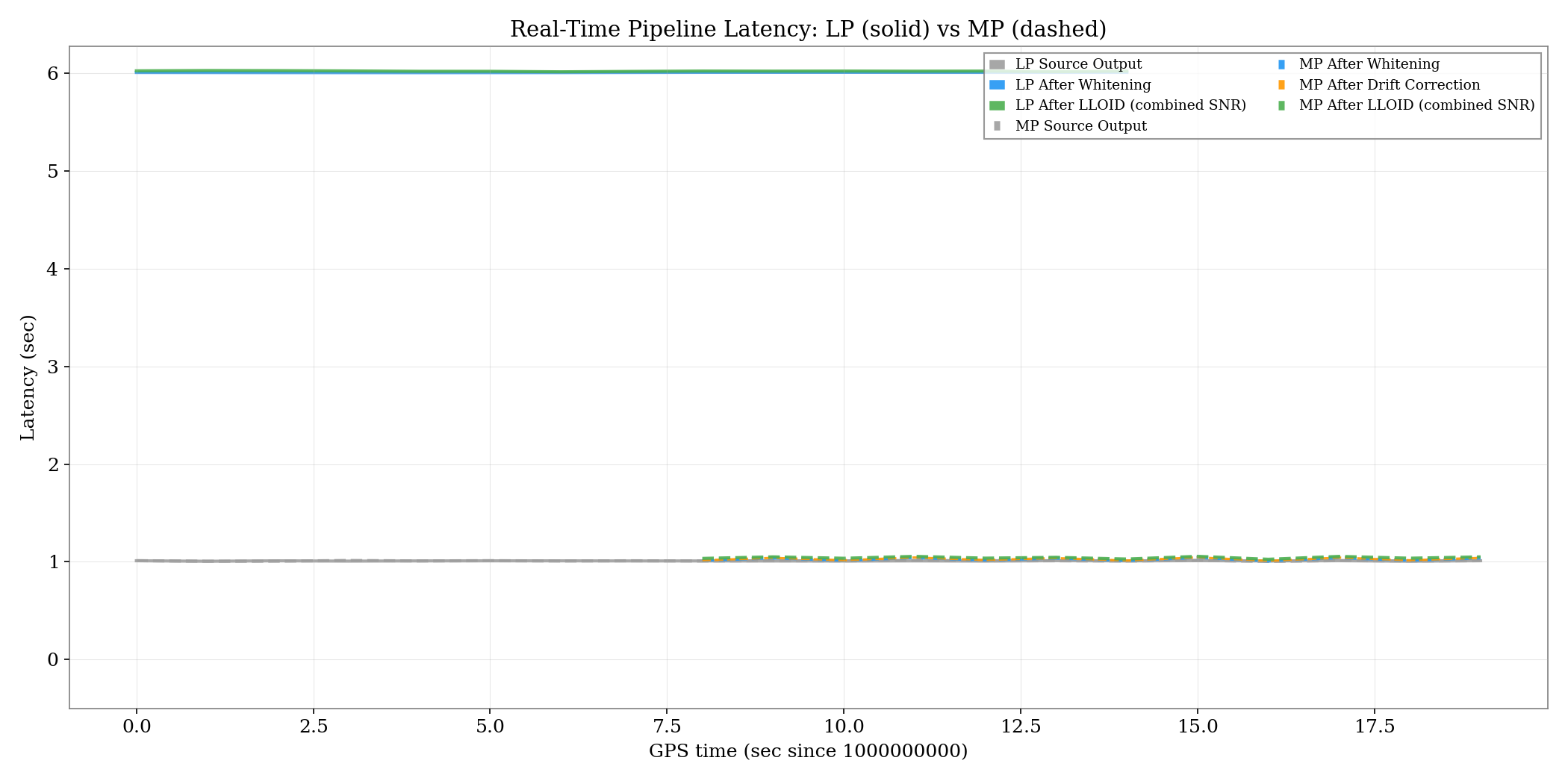
The payoff is operational. Implemented inside the production sgnl matched-filter pipeline at a 4-second noise-estimation cadence, the framework reduces whitening latency by 1.0 second (33%) relative to the linear-phase baseline, confirmed both in controlled local tests and on live O3 replay data at production scale. Pushing to sub-second pipeline cadence, stride-reduction experiments show that up to 91% of the baseline trigger latency can be eliminated.
That is latency returned to the astronomers waiting downstream: earlier alerts, without sacrificing the detection sensitivity or pointing accuracy that make those alerts worth acting on.